Do You Make These Simple Mistakes In Low Voltage Armored Power Cable?
페이지 정보

본문
For instance, during building, accidental impacts or compression could harm the interior conductors or insulation layers. Taking steel-wire armored cables as an example, their armor consists of a number of high-strength steel wires tightly wound collectively, providing resistance against mechanical stresses like impacts and compression during construction. This armor layer sometimes consists of steel tape, steel wire, or aluminum tape. Their construction consists of a conductor, insulation layer, inside sheath, armor layer, and outer sheath. Low-Voltage Electrical Cable can undertake a galvanized steel strip (STA) or steel wire armor (SWA) structure to enhance the cable's resistance to mechanical influence. Armored cables, however, incorporate the extra steel armor layer, resulting in a more complicated structure with increased general hardness and weight. Armored cables embody a metallic layer that adds durability in harsh environments, whereas unarmored cables lack this layer, making them lighter, more flexible, and price-efficient. Armored cables are built for endurance. In terms of mechanical protection, non-armored cables are comparatively weak and prone to break from external mechanical forces.
 Special goal energy cables for overhead applications are often sure to a excessive energy alloy, ACSR, or alumoweld messenger. For applications liable to hydrocarbon attack and moisture penetration, especially relevant to the oil, gasoline and petrochemical industries, hydrocarbon resistant armoured cables are your best option. Opt for unarmored cables in indoor, protected areas the place cost-effectiveness and adaptability are extra necessary than energy. That is a serious cause they're preferred in homes and small industrial setups. Cables consist of three main elements: conductors, insulation, and a protective jacket or sheath. 1. Ideal for direct burial or set up in trays and ducts the place mechanical harm may occur; armored cables are recommended for such conditions. Electrical energy cables are typically installed in raceways, together with electrical conduit and cable trays, which can comprise a number of conductors. They'll resist crushing forces, survive underground burial, and even deter rodent harm, giving them a protracted service life.Unarmored cables are much less durable and solely dependable in properly-protected environments, akin to within partitions or conduits. We offer a wide range of Control Cables, together with Unarmoured Cables and versatile Control Cables, which are customizable as per the specifications offered by our clients.
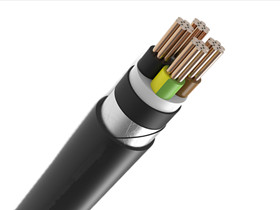 Structurally, non-armored cables consist solely of conductors, insulation, and sheathing, that includes a relatively easy design and softer texture that facilitates bending and set up. The protective layer in armored cables makes them stiff and less versatile, requiring a wider bending radius throughout installation. Its rugged polymeric AIR BAG™ armor eliminates the concern of kinking or breaking of corrugated aluminum armor during set up or subsequent bending in service, in addition to poor performance in areas of excessive vibration (e.g. motor connections) that is usually associated with Type MC-HL cables. Top Cable manufactures and supplies a complete range of aluminium wire and steel wire (AWA/SWA) armoured cables for indoors, outdoors, ducts and direct burial underground installations the place extreme mechanical stresses are current. They carry out well in rough terrains and are suitable for prime-tension (HT) and low-tension (LT) energy distribution. For instance, low-voltage power cables can typically run as much as 300 meters with out significant voltage drop, while information cables like Ethernet could also be limited to 100 meters. Unarmored cables are typically limited to indoor or low-risk environments, akin to inside conduits, residential wiring, or building control techniques.
There are advanced manufacturing equipment and expert employees, as well as mature testing tools. A2: We've constructed a provincial "manufacturing unit of the future" and have the largest single and most effective particular cable clever production workshop in Asia. In nuclear business applications the cable could have special necessities for ionizing radiation resistance. An unarmored cable does not have the metallic protective layer. Armored cable is a specialized cable that incorporates a metallic armor layer onto the standard cable structure, significantly enhancing its protective capabilities. This reduces the chance of electric shock to personnel and equipment harm, enhancing the safety and reliability of the electrical system. Armored cables, nevertheless, leverage their sturdy armor layer to successfully withstand numerous mechanical stresses, considerably lowering the risk of cable harm. AWA cables, (aluminium wire armoured) are constructed with a layer of corrugated aluminium tape wrapped around the insulated cores, offering protection and suppleness whereas sustaining good mechanical power. Installation cost is diminished as bulky, costly metallic armor grounding glands aren't required. Unarmored Cable relies upon in your set up site. Unarmored Cable debate ensures long-term performance, safety, and efficiency in electrical and communication techniques.Related Article:Difference Between SWA and STA CableSWA Armoured Cable: A complete GuideArmoured Cable Uses in ElectricalWhat is Armoured Cable?
- 이전글서울 대전 대구 부산 인천 광주 울산 창원 남양주 이혼전문변호사 정보 26.07.14
- 다음글비아그라 자주 묻는 질문 모음 – 한 번에 정리해드립니다 26.07.14
댓글목록
등록된 댓글이 없습니다.